



Most copackers will tell you they can handle everything. The ones running at 95% utilization in June will still say yes in the RFP. You find out what that actually means in October, when your promotional program is sitting in a queue and your retail window is closing. The question is not whether your copacker has capacity on paper. The question is whether they have built their operation to serve both short-run flexibility and sustained high-volume output, at the same time, without sacrificing one for the other.
According to PMMI's 2024 Contract Packaging and Manufacturing report, 48% of brands use contract packaging services specifically for short or limited runs that would be costly or difficult to implement internally. That is nearly half the market looking for flexibility, not just throughput. Understanding what dual capability looks like operationally, and which questions to ask during evaluation, protects your Q4 before the conversation even starts.
If you are actively planning a copacker evaluation, the contract packaging services overview at Industrial Packaging is a practical starting point for understanding what a secondary packaging partner should be able to demonstrate.
Why Do Most Copackers Specialize in One or the Other?
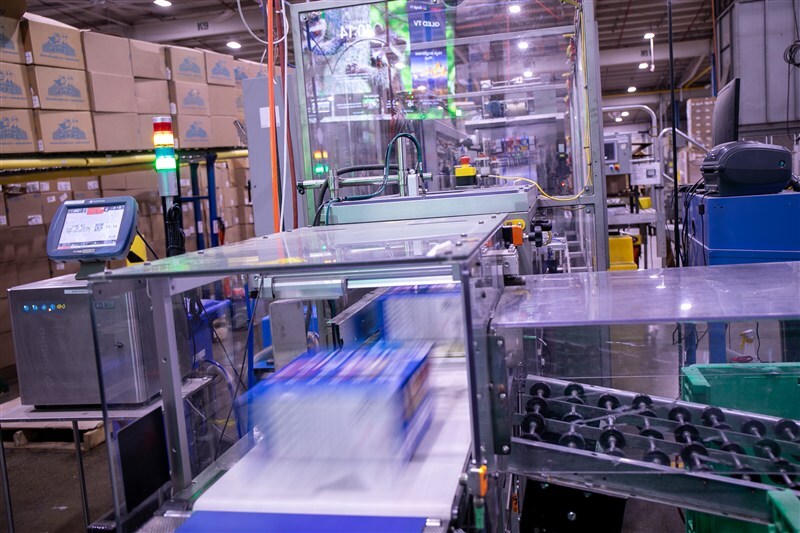
Most contract packagers are optimized for either high-volume sustained production or short-run flexibility, because the operational investments required for each are genuinely different, and building for both is harder than it looks.
High-volume copackers invest in dedicated automated lines tuned to a narrow set of formats. They run best when the same SKU runs week after week with predictable forecasts. Changeovers are expensive for them. Minimum order quantities exist because the economics only work at scale. If you bring them a 75,000-unit limited edition display program, you are asking them to disrupt the machine they built for your 1.5-million-unit 52-week program.
Short-run specialists go the other direction. They build for flexibility: manual or semi-automated lines, cross-trained labor, smaller footprints. They can turn a promotional program around quickly, but ask them to absorb a club store replenishment surge at 400,000 units per week and the cracks appear fast. Capacity is finite, and the infrastructure that enables nimbleness at low volume does not automatically scale.
The structural reason this split persists is that CPG companies have increasingly moved smaller volume and new product production externally, specifically so their internal manufacturing lines can focus on large commercial runs without changeover disruption. That decision makes sense operationally, but it creates a sourcing challenge: the copacker serving your test market program may not be capable of scaling when that SKU becomes a national rollout, and the copacker running your club store replenishment may have no practical mechanism for your regional promotional insert program.
For a deeper look at how volume affects per-unit pricing on both short and sustained runs, the contract packaging cost breakdown covers the key variables in detail.
What Does Dual Capability Actually Look Like Operationally?
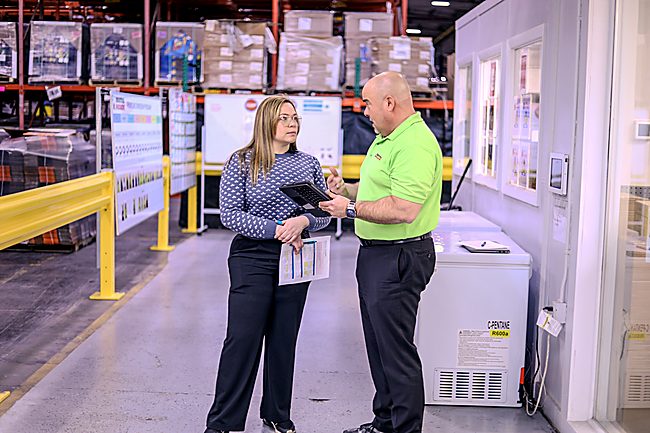
Dual capability is not a marketing position. It is a set of specific operational choices: modular production lines, cross-trained labor, honest utilization rates, and scheduling systems that can absorb a volume change mid-production without collapsing the following week's program.
The utilization rate is the most diagnostic number to request. A facility running at 95% capacity year-round cannot absorb a Q4 surge without displacing existing commitments or rushing with undertrained staff. Both outcomes create quality risk. A facility operating at roughly 60% utilization has engineered-in buffer: room to extend shifts, bring in a second crew, or pull forward a run to accommodate a retailer's revised PO. That buffer is not inefficiency. It is the operational mechanism that makes flexibility real rather than theoretical.
Industrial Packaging operates at approximately 60% utilization across its Webster, Massachusetts headquarters, and maintains more than 400,000 square feet of capacity across North America. That headroom is what allows the team to handle a club store replenishment program and a 10-business-day promotional turnaround from the same facility, without one cannibalizing the other.
Cross-trained labor is the second structural requirement. A workforce where every operator knows one machine is a workforce that cannot flex. Cross-training means that when volume surges on the multipack line, available labor can be redirected without a two-week onboarding cycle. It also means that a short-run display program does not require pulling people off a running production commitment. Industrial Packaging's teams are built this way, which is why the throughput capacity of 1,500,000 multipacks per week does not require the facility to be at maximum staffing every shift.
Modular production lines matter most for variety pack and club pack complexity, where SKU mixing and sequencing can break a purely automated line. A line that can be configured for a mixed multipack without a multi-day changeover is the difference between taking a promotional program and turning it away. That configuration flexibility is what makes a standard 10-business-day turnaround achievable on smaller runs, not just large ones.
The comparison below illustrates how a dual-capability copacker differs from one optimized for a single volume profile:
| Operational Factor | High-Volume Specialist | Short-Run Specialist | Dual-Capability Copacker |
|---|---|---|---|
| Utilization rate | 85-95% (limited buffer) | Variable (low volume ceiling) | ~60% (engineered headroom) |
| Minimum order quantity | High - line economics require scale | Low - built for small batches | Flexible - scales with program type |
| Q4 surge absorption | Difficult - competes with existing work | Difficult - infrastructure ceiling | Yes - flex labor, open shift capacity |
| Short-run turnaround | Slow - changeover costs are high | Fast - built for it | Fast - 10 business days standard |
| 52-week sustained programs | Strong | Weak | Strong |
| Club store and multipack complexity | Strong if format is fixed | Limited throughput ceiling | Strong - modular line configuration |
| Labor model | Fixed headcount | Small core team | Flex labor - scales up for Q4, scales down for Q1 |
What Questions Should You Ask Before Peak Season Commits?
The right questions expose the gap between what a copacker says and what their operation can actually deliver, specifically around minimum run sizes, maximum weekly throughput, utilization, and how they handle in-flight volume changes.
Start with utilization. Ask what percentage of total capacity is currently committed, and how that number changes between January and October. A copacker who cannot answer that question precisely does not have a scheduling system that can protect your Q4 window. Premium capacity windows in October and November often commit four to six months in advance at high-volume operations. If you are having this conversation in August, you are already late at some facilities.
Ask specifically about minimum order quantities for promotional programs, limited editions, and test markets. A 500,000-unit run costs less per unit than a 100,000-unit run, and every copacker knows this. The question is whether their MOQ structure makes a 100,000-unit program economically viable at all, or whether you are forced to over-produce to meet a floor that was built for their operational convenience, not your brand's needs.
Ask how they handle an in-flight volume change. If your retailer revises a club pack PO upward by 30% while the job is running, can they extend the run, or does the additional volume get scheduled three weeks later? The answer to that question tells you more about their actual flex capacity than any capacity chart they share in a presentation.
Ask about labor. How do they staff for Q4? If the answer is temporary hires brought in starting in September, ask how those workers are trained and how quality is maintained during ramp-up. If the answer is cross-trained permanent staff on flexible shift schedules, that is a different operational risk profile entirely. The full list of questions to ask copackers about seasonal surge capacity covers the complete evaluation framework.
Finally, ask about quality performance under volume pressure. Complaint rates, fill rates, and first-pass yield should not degrade during peak production. A copacker whose quality metrics are only valid at steady-state volume is not a partner for a Q4 program. Industrial Packaging's complaint rate of 0.76 per million units company-wide, and 0.2 per million for one long-term Fortune 500 customer, reflects performance across both high-volume runs and smaller programs.
For context on how these questions fit into a broader vendor evaluation, the outsourcing evaluation guide at Industrial Packaging walks through the decision criteria in detail.
How Industrial Packaging Handles This
Industrial Packaging is independently owned and has operated as a contract packaging partner to Fortune 500 CPG brands for more than two decades. The company was founded in 1953 and has never been acquired by a private equity firm or rolled into a larger platform. That independence means the team is accountable to its customers, not to a portfolio management cycle.
When a brand brings a new program, whether it is a 52-week club store replenishment or a regional promotional limited edition, the same dedicated team handles it. There are no account management layers between you and the people making production decisions. You have direct access to senior leadership, including the President and COO, when it matters. That structure matters most when something changes mid-program and a decision needs to happen in hours, not across a ticket queue.
Industrial Packaging manages material supplier relationships directly, which means brands are not coordinating between multiple vendors to get components to the line on time. The team communicates proactively, before you have to ask, about capacity allocation, material availability, and schedule status. For Q4 planning specifically, that means the conversation about capacity reservation happens well before the volume spike arrives, not the week before a retailer window closes.
The flex labor model at Industrial Packaging means scaling up for peak season without the training-cycle risk of temporary hires, and scaling back down in January without carrying overhead that does not match the work. That symmetry is what makes the operation viable for both short-run promotional programs and sustained high-volume production within the same facility.
If you are evaluating whether your current copacker can realistically support both program types, or if you are building a dual-source strategy for the first time, the outsource with IP page is the right starting point for a direct conversation.
Frequently Asked Questions
These are the most common questions brands ask about Can Your Copacker Handle Small Runs and Peak Volume? when evaluating contract packaging partners.
Can a copacker realistically handle both promotional short runs and 52-week high-volume programs?
Yes, but only if the facility is operationally built for it. Industrial Packaging handles both program types because the labor model, line configuration, and capacity utilization are structured to support short-run flexibility without disrupting sustained volume commitments. Most copackers specialize in one profile or the other, so the key is asking the right questions during evaluation rather than assuming dual capability exists.
What is a reasonable minimum order quantity for a promotional or test market packaging program?
Minimum order quantities vary by copacker and are usually driven by the economics of their production setup. Copackers optimized for high-volume runs tend to impose MOQs that make small test market or limited edition programs impractical. If your brand regularly runs promotional or regional programs, the MOQ question should be one of the first you ask during any vendor evaluation, before discussing pricing or lead times.
How does Industrial Packaging manage Q4 volume surges without compromising quality?
Industrial Packaging uses a flex labor model built on cross-trained permanent staff rather than seasonal temporary hires, which means quality processes stay consistent even as production volume scales. Proactive capacity planning conversations happen well before peak season windows close, so brands know where they stand before a retailer deadline creates urgency. This approach keeps quality metrics stable across both surge and steady-state production.
Why does copacker utilization rate matter when evaluating seasonal capacity?
A copacker running near maximum utilization has no structural buffer to absorb a volume spike. When demand increases suddenly, a fully committed facility either displaces existing customers, rushes with undertrained staff, or declines the additional volume entirely. A partner that maintains meaningful open capacity as a deliberate operational choice has a real mechanism to say yes when your Q4 program grows beyond forecast.
What should I ask Industrial Packaging about short-run turnaround times during peak season?
Industrial Packaging maintains a standard turnaround on ongoing orders even during periods of elevated volume, because the flex labor and capacity structure are designed to prevent peak season from cannibalizing existing commitments. The right questions to ask are how capacity is allocated between sustained programs and short runs, how in-flight volume changes are handled, and how far in advance capacity windows should be reserved for Q4 promotional programs.
Ready to Evaluate Your Options?
If you are exploring contract packaging partners or want to understand what a structured copacking partnership looks like, start a conversation with Industrial Packaging.