



Kitting is no longer a niche add-on service buried in a copacker's capabilities deck. As Packaging World noted in "Kitting Moves Beyond Hidden-Market Status," kit packaging is becoming an essential service of contract packagers in meeting CPG companies' need to push time-sensitive products to market. Variety packs, promotional bundles, club-store configurations, and seasonal programs are driving a volume of assembly work that most primary production lines cannot absorb without compromising throughput on core SKUs.
If you're a VP or Director of Operations or Supply Chain at a $500M-plus CPG brand, you likely already have a copacker. The question isn't whether to outsource kitting. It's how to tell whether a potential partner can actually handle it at the scale and compliance level your retail accounts demand. This article walks through what large-scale retail kitting really involves, when outsourcing makes sense, what separates a capable copacker from a capable-sounding one, and why the copacker versus 3PL decision matters more than most brands realize. Industrial Packaging handles contract packaging for Fortune 500 CPG brands and runs kitting programs at a scale that informs everything in this article.
What Does Large-Scale Retail Kitting Actually Involve?
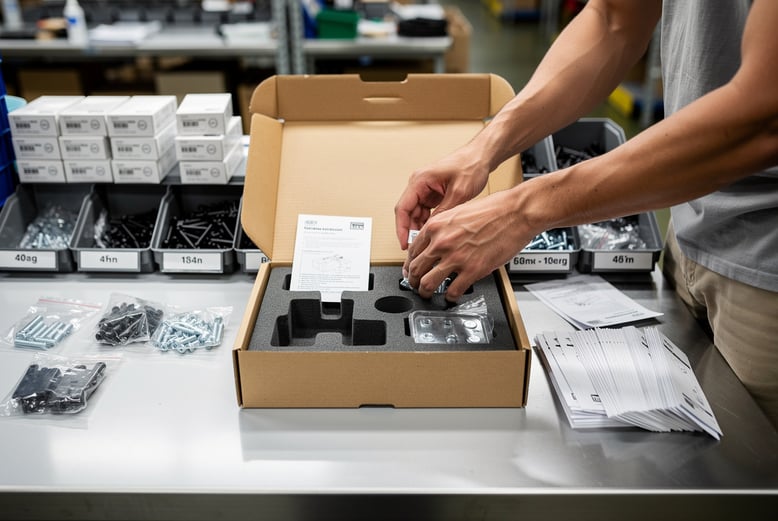
Retail kitting at volume is an intersection of packaging engineering, inventory control, allergen management, retailer compliance, and speed to market, all happening simultaneously on a production floor.
A variety pack, promotional bundle, or club-store configuration may look simple on the shelf. Getting it there without errors is operationally demanding. In practice, a kitting project requires managing multiple SKUs, differing lot codes, variable counts, promotional inserts, retailer-specific case configurations, tight production windows, and precise labeling standards, all governed by a bill of materials (BOM) that has to be exact every single time.
Variety packs combine multiple SKUs that may carry different allergen profiles and require sequential assembly in a specific order. Many snack formats use nitrogen-inflated primary bags that must be handled without compromising seal integrity during overwrap assembly. A copacker without sustained high-volume experience in these formats will encounter rework and quality failures that show up as chargebacks on your account. According to PMMI's 2024 Contract Packaging and Manufacturing report, 59% of brand owners cite access to specialized equipment and packaging formats as the primary driver for using contract services, ranking above cost savings. For kitting specifically, that specialization includes WMS systems configured for kit BOMs, reverse kitting capability for returns or rework, and lot-level traceability through assembly.
Industrial Packaging assembles more than 405,000 kits per week across programs that include multi-SKU variety packs, club-store bundles, and promotional configurations. That volume isn't a headline stat, it's the operational context that makes a difference when your program ramps for Q4 or a retailer changes a specification mid-season. You can explore the full scope of multipack and display assembly services to understand how kitting fits within a broader secondary packaging program.
When Does Outsourcing Kitting Make Sense vs. Running It In-House?
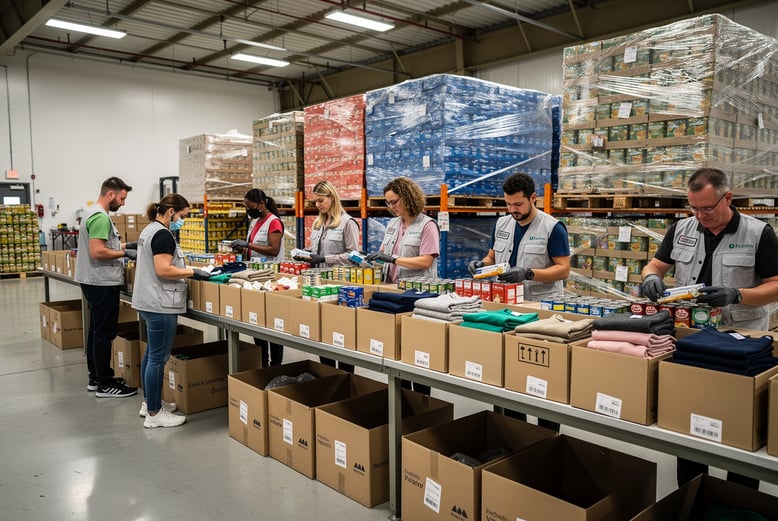
Outsourcing kitting makes sense when the volume, complexity, or compliance requirements of a retail program exceed what your primary production floor can absorb without creating throughput trade-offs on core SKUs.
The honest version of this calculation is harder than most finance teams expect. Companies typically believe in-house assembly costs a certain amount per unit, when the real number is often 40% higher once you factor in labor overhead, line changeovers, secondary equipment maintenance, floor space consumption, and quality failures. The real ROI of outsourcing goes beyond per-unit savings. It includes floor space recovery, labor redeployment to core production, eliminated capital expenditure on secondary packaging equipment, reduced retailer chargebacks, and faster speed to market. For a $500M-plus CPG brand running kitting in-house, outsourcing secondary packaging typically frees floor space that generates more revenue as primary production capacity.
The PMMI report found that 48% of brand owners use contract services specifically to test new products or packaging formats and to offer customized packages for short or limited runs, exactly the use cases that define promotional kitting windows. When a club-store program runs for 12 weeks and then rotates out, building internal infrastructure for it is rarely the right answer. The same applies to seasonal programs: a copacker with flex labor can scale up for Q4 demand and scale back down for Q1 without your brand absorbing the staffing cost in either direction.
The in-house versus outsource decision also changes when retailer compliance enters the picture. If your Costco or Target account requires SQF Level 2, FDA registration, and documented allergen control as conditions of doing business, those aren't capabilities you build quickly. A copacker that already holds them removes that barrier entirely. You can find a more detailed breakdown of the cost side of this decision at the contract packaging cost guide.
| Factor | In-House Kitting | Outsourced Kitting (Copacker) |
|---|---|---|
| Capital requirement | High (equipment, floor space, labor) | None (absorbed by copacker) |
| Scalability for seasonal peaks | Limited by fixed headcount and equipment | Flex labor scales with demand |
| Retailer compliance certifications | Must be built and maintained internally | SQF Level 2, FDA registered, AIB inspected |
| Allergen segregation | Shared with primary production environment | Dedicated allergen control program |
| BOM and lot traceability | Dependent on ERP configuration | WMS configured for kit BOMs and lot tracking |
| Speed to market for new programs | Constrained by internal scheduling | Standard 10-business-day turnaround |
| Per-unit cost transparency | Often underestimated by 40% | Fixed pricing with optional index-tied material costs |
Copacker vs. 3PL for Kitting: Why the Distinction Matters
A 3PL can assemble kits. A copacker integrates kitting with secondary packaging, quality assurance, food safety compliance, and allergen control in a single facility, eliminating the handoff risk that creates chargebacks and compliance failures.
This distinction is operationally significant. When kitting happens at a different facility than secondary packaging or fulfillment, you have a handoff. Every handoff is a point where your BOM, label requirements, and quality standards have to travel between people who may not be on the same page. You're also paying freight to move product between facilities. For food and beverage brands working with tight shelf-life windows, that extra leg is not just a cost problem, it is a timing problem.
3PLs bundle repacking with warehousing, fulfillment, and distribution, which creates apparent efficiency. But in-house operations and 3PLs doing light repacking generate more retailer chargebacks because they lack dedicated QA infrastructure, food safety certification requirements, and systematic retailer specification verification. A copacker focused on secondary packaging and kitting operates with the compliance infrastructure that major retailers require as a condition of doing business, not as a value-add. The Contract Packaging Association has documented that secondary packaging represents a growing share of outsourced work as CPG brands consolidate SKUs at their own facilities and shift format variations to specialized partners.
The specialized copacker model also eliminates priority conflicts. When primary and secondary packaging compete for the same resources at a 3PL or hybrid facility, your kitting program loses that negotiation every time a filling line has a scheduling issue. When a retailer changes a promotion window or a specification update requires relabeling a significant volume of units, a secondary-only copacker's scheduling team doesn't have to negotiate around filling or bottling commitments. Industrial Packaging operates exclusively in secondary packaging and kitting, which means your program is never competing for floor time with primary production. If you're evaluating whether a partnership makes sense, the outsourcing overview walks through how Industrial Packaging structures new programs from onboarding through production.
What Specifically Should You Evaluate in a Copacker for Kitting?
Evaluate on mixed-SKU accuracy, allergen transition protocols, BOM control and traceability, retailer compliance certifications, and the copacker's demonstrated ability to handle program complexity without adding coordination burden to your team.
Start with the error rate on multi-SKU programs. Ask for the copacker's process for managing allergen transitions between product runs. If they cannot describe a documented allergen control program with specificity, that is a disqualifying gap for any food brand shipping into major retailers. Industrial Packaging holds SQF Level 2 certification (GFSI benchmarked), is FDA registered, and maintains a documented allergen control program with mock recalls conducted twice per year across both shifts. In April 2026, an unannounced AIB inspection scored Industrial Packaging 980 out of 1,000, the highest score in the company's history, at the Level of Excellence designation.
Ask for a traceability demonstration. Request documentation for a randomly selected production date and ask for both a forward trace (starting from inbound materials) and a backward trace (starting from finished goods). A capable copacker should complete a full mock trace within four hours. This matters because your Costco or Target account may require it as part of a supplier audit, andyour copacker's traceability capability is your traceability capability in that moment.
Evaluate BOM management specifically. Ask how the copacker handles effective-dated BOMs for seasonal or promotional programs, what happens when a component SKU changes mid-run, and how reverse kitting is handled for returns or rework. These are not edge cases at volume. They are routine operational realities on any program running 405,000 kits per week across multiple retailer accounts with different specifications.
Finally, evaluate the communication model. Retailer compliance requirements change. Costco's depot delivery windows tighten. Target's Perfect Order Program introduced $0.75-per-defective-carton charges and 100% ASN accuracy requirements in 2025. Walmart's OTIF penalties run at approximately 3% of cost of goods sold per non-compliant case. Your copacker's ability to catch a specification change before a load ships is worth more than any per-unit rate difference. Industrial Packaging provides direct access to senior leadership, not account-management layers, and operates with a cohesive dedicated team that learns your program specs and communicates proactively before you have to ask. The full scope of how that partnership model works is detailed at contract packaging services.
How Industrial Packaging Handles This
Industrial Packaging approaches kitting programs differently than most copackers because the structure of the operation is built around dedicated focus. There are no primary production lines competing for floor time. Every program, from a promotional variety pack to a club-store bundle, runs through a team that knows the BOM, knows the retailer specifications, and knows the allergen segregation requirements before the first unit is assembled.
The team assigned to your program learns your specs. Not just at onboarding, but as specs evolve across seasons, retailer updates, and promotional windows. When a compliance requirement changes at a major retailer, Industrial Packaging's team raises it proactively. You do not find out about a labeling requirement from a chargeback. That communication model is structural, not situational. It is how the operation runs every day, across every account.
Industrial Packaging is independently owned, not backed by private equity or operating as a subsidiary of a larger fulfillment network. That matters for kitting programs because the decision-makers are accessible, the organization is not layered, and the team assigned to your program has direct lines to the people who can resolve problems. When you need to discuss a BOM change, a component shortage, or a retailer audit requirement, you are talking to the people who run the operation, not a relay through an account management function.
If you are evaluating partners for a kitting program and want to understand how Industrial Packaging structures new programs, including ramp timelines, pricing transparency, and capacity fit, the outsourcing overview is the right starting point. You can also explore the multipack and display assembly capabilities to see how kitting integrates with broader secondary packaging programs at Industrial Packaging.
Frequently Asked Questions
These are the most common questions CPG brands ask when evaluating a copacker for large-scale kitting programs.
What kitting services should a copacker offer for large-scale CPG programs?
A copacker handling large-scale retail kitting should offer multi-SKU variety pack assembly, promotional bundle builds, club-store configurations, insert management, BOM control, lot-level traceability, allergen segregation between product runs, and retailer-compliant labeling. Industrial Packaging operates all of these capabilities under a single roof, eliminating the handoff risk that occurs when kitting and secondary packaging are split across separate facilities.
How is copacker kitting different from 3PL kitting for CPG brands?
A 3PL bundles kitting with warehousing and distribution, which can create apparent efficiency but typically lacks the food safety certifications, dedicated QA infrastructure, and allergen control programs that major retailers require. A copacker focused on secondary packaging and kitting integrates quality assurance and compliance into the assembly process itself, which reduces chargebacks and compliance failures. Industrial Packaging operates exclusively in secondary packaging and kitting, so your program is never competing for floor time with primary production.
What certifications should I require from a copacker for retail kitting programs?
For kitting programs shipping into major retailers like Costco, Target, and Walmart, you should require SQF Level 2 certification (GFSI benchmarked), FDA registration, a documented allergen control program, and a strong track record on unannounced food safety inspections. Industrial Packaging holds all of these and conducts mock recalls twice per year across both production shifts to ensure traceability readiness.
How do I evaluate BOM accuracy and traceability at a copacker for kitting?
Ask the copacker to demonstrate a mock trace using a real production date, both forward from inbound materials and backward from finished goods. A capable partner should complete this within four hours. Also ask how they handle effective-dated BOMs for seasonal programs and what their process is for managing component changes mid-run. These are routine operational situations at volume, not edge cases, and how a copacker handles them reveals the maturity of their kitting operation.
When does it make financial sense to outsource kitting rather than run it in-house?
Outsourcing kitting typically makes financial sense when the true cost of in-house assembly, including labor overhead, floor space, equipment maintenance, quality failures, and retailer chargebacks, exceeds what a specialized copacker charges per unit. The comparison is almost always closer than brands expect, and the operational benefits of outsourcing, such as flex labor for seasonal peaks and built-in compliance infrastructure, add value that per-unit rate comparisons alone do not capture. Industrial Packaging can help you model the real cost comparison for your specific program.
Ready to Evaluate Your Options?
If you are exploring contract packaging partners or want to understand what a structured copacking partnership looks like, start a conversation with Industrial Packaging.